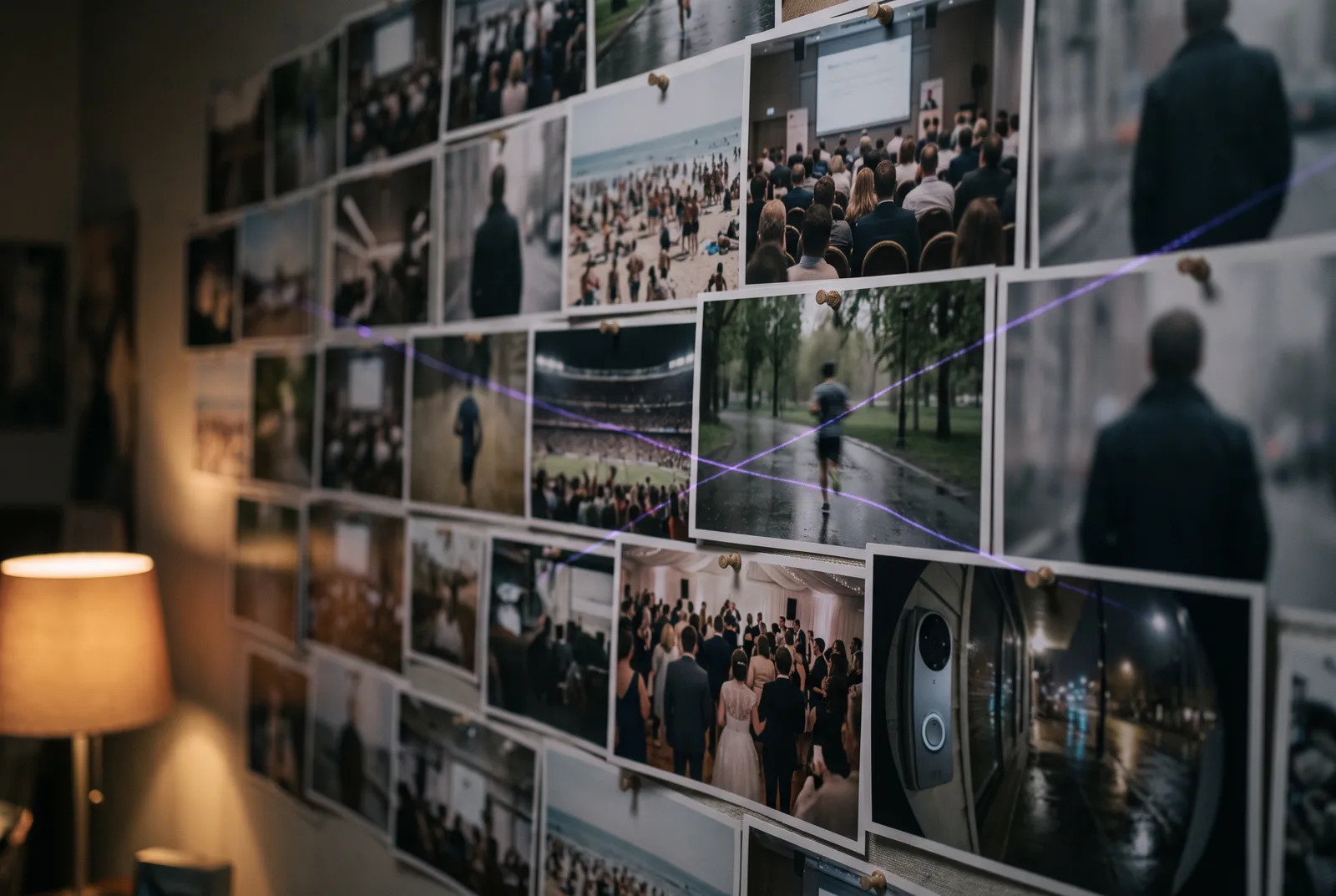
A face-search engine does not need you to upload anything. It crawls the public web, finds every image with a face in it, and turns each face into a searchable record. Whether that image is yours is irrelevant to the machine. What matters is that your face was in frame and the page was public. That is a much bigger set of photos than the ones you posted, and it is the set this list is about.
Why this matters now
For most of the history of photography, a picture of you in someone else’s album was harmless because nobody could connect it to you. A stranger’s holiday snap with you in the background was, for all practical purposes, anonymous. Face search ended that. Once a face can be used as the query, every public photo containing it becomes a link back to the person, no name required.
That is why deleting your own photos changes less than people expect. The engines are indexing the web as it is, not your account as you curate it. We wrote about that specific disappointment in why deleted photos can still turn up in face search. This post is the companion: the places those photos tend to live.
1. Other people’s group photos
The birthday dinner, the office party, the stag weekend, the reunion. Someone else took the picture, someone else posted it, and you are the third face from the left. You may have been tagged, or you may not have been; to a face-search engine tags are decoration. If the post is public, the face is indexed.
This is the largest category by a distance, and the hardest to reason about, because you have no list of it. You cannot audit photos you never knew were taken. It is also the one people feel least entitled to do anything about: it is not your post, and asking a friend to take down a happy memory feels petty. We looked at that social awkwardness in the group-photo consent problem.
2. The background of a stranger’s trip
You walked past a fountain in a city you visited once. A couple was taking a photo in front of it. You are in it, half-turned, holding a coffee. They posted it. That is the whole story, and it is enough.
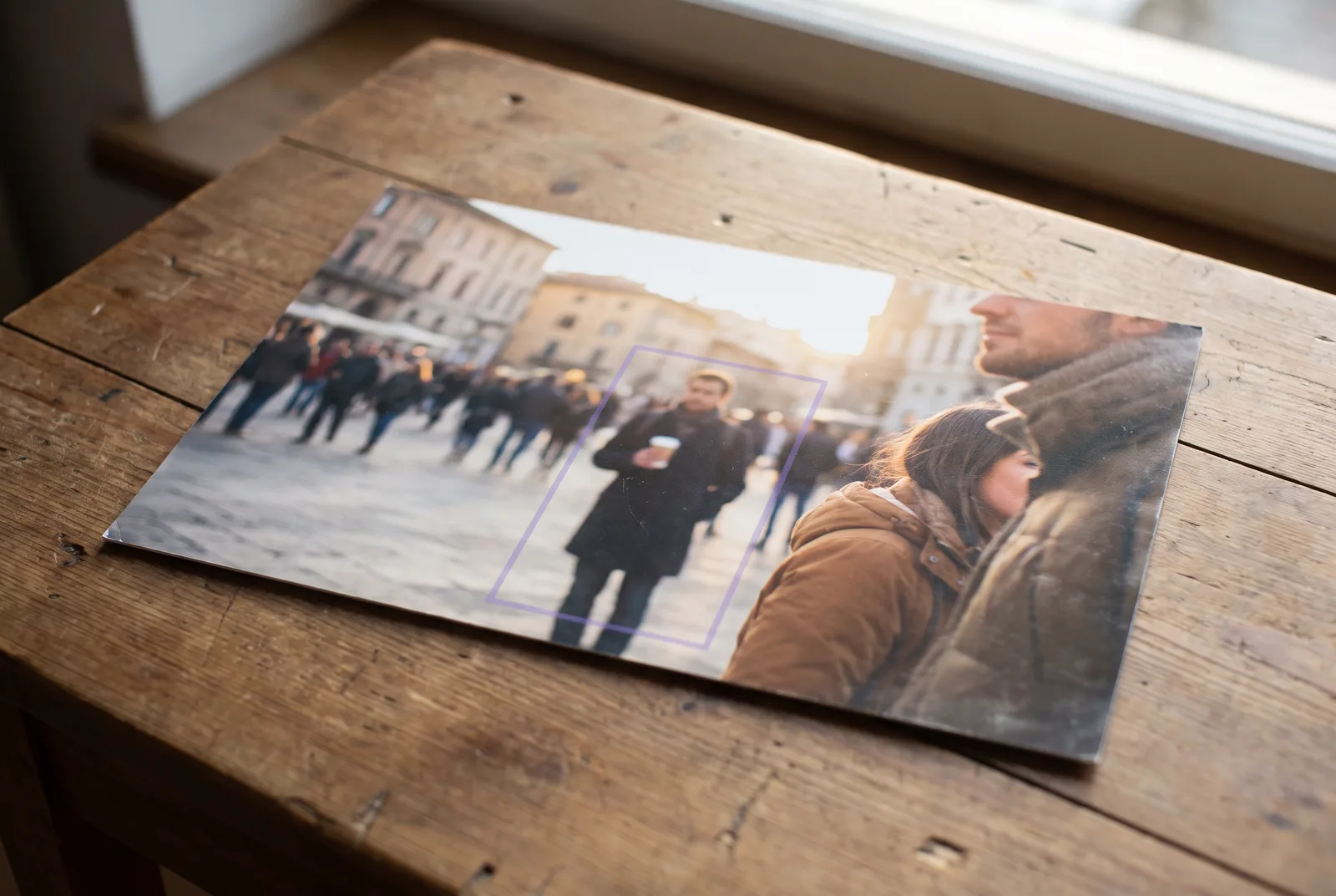
Background faces are small, often blurred, and frequently still good enough. Detection models are built to find faces at a wide range of sizes and angles, because that is what real photos contain. A face that is a few dozen pixels across can still produce a usable match against a clear reference photo of the same person. This category is uncomfortable precisely because there is nothing you could have done differently short of not being in public.
3. Event photographers’ galleries
Conferences, races, festivals, weddings, charity dinners, industry awards. A professional photographer is hired, shoots hundreds of frames, and publishes a gallery so attendees can find themselves. Sometimes the gallery is password-protected. Often it is not, because the whole point is that people can find it easily.
These galleries are unusually valuable to face-search engines for a simple reason: the photos are sharp, well lit and frontal, because that is what a professional produces. If a blurry background face is the low end of what an engine can use, a race photographer’s finish-line shot is the high end. Your conference badge photo, the one taken against a branded backdrop, belongs in this category too.
4. Digitised archives
University yearbooks, alumni magazines, club newsletters, company annual reports, local newspapers going back decades. Libraries, historical societies and alumni associations have been scanning these for years and putting them online, usually with good intentions and no thought about face search, which did not exist when most of the scanning started.
The result is that a photo of you from a very long time ago may be a public, indexed image today. Faces change with age, but not as much as people hope, and modern models are specifically trained to match across years. If you were ever in a printed publication that has since been digitised, that photo may be one of the results a search on your face returns.
5. Local news and community pages
A charity run, a town-hall meeting, a shop opening, a school-board vote, a protest. Local outlets photograph crowds, and community groups post the pictures to their own pages. You may have been quoted; more often you were simply present. Either way the image is journalism, it is public by design, and it stays online indefinitely.
This category is worth calling out because people tend to assume that being photographed at a public event is a one-time, contained thing. It is not. A face captured at a demonstration in one year is a face searchable in every year after.
6. Camera footage shared to the neighbourhood
Doorbell cameras, dashcams and shop CCTV produce a constant stream of faces, most of which stay private on someone’s device. Some do not. Clips get posted to neighbourhood apps, community groups and local forums, usually with a caption like “anyone recognise this person?” The person is frequently a delivery driver, a jogger, or someone who knocked on the wrong door.
Once a clip is public, the still frames inside it are as indexable as any photograph. This is the category with the sharpest edge, because the image is often posted in order to identify someone, and face search makes that far easier than the poster probably realised. We covered the wider trend in they didn’t run your plate, they ran your face.
7. Old accounts you forgot
The forum you used at twenty. The dating profile from before your relationship. The professional network you joined for one job hunt. The photo-sharing site that still exists, quietly, with your uploads on it. These are technically photos you did upload, but you did not upload them to this internet, the one where a face is a search term. You uploaded them to a web that, at the time, could not do that.
Forgotten accounts matter twice over. The photos themselves are findable, and they are often the clearest, most deliberate portraits of you online, which makes them ideal reference images for matching against everything else on this list.
What you can do
Reading a list like this, the natural instinct is to go hunting: find every photo, ask every poster, take it all down. For a handful of items that is worth doing. For the list as a whole it is not achievable, because most of these photos are not yours to remove and many you will never locate.
The more useful way to think about it is that all seven categories share one point of failure. The photos are scattered across thousands of sites you do not control, but they only become findable because a small number of face-search engines have indexed them. Those engines have opt-out and removal processes. Ask them to stop indexing your face, and every photo in every category above becomes what it used to be: a picture in someone’s album that nobody can trace back to you.
That is what FacePrivacy does. We file opt-out and removal requests with the facial-recognition engines we support, on your behalf, and re-file them as necessary, because the engines re-crawl the web and a request that worked in spring can need repeating in autumn. We cannot guarantee any engine’s response, and we do not touch the underlying photos. We work on the thing that connects them to you.
Most photos of you were taken by someone else.
FacePrivacy files opt-out and removal requests with the major face-search engines on your behalf and re-files them monthly, so the photos you never uploaded stop pointing back at you.
Get started →